

Do you get stressed out just thinking about putting together your wedding invitations?
What information actually needs to be included? How do you word an invitation when you have a blended family? How do you politely tell guests your wedding is adults only? And in the age of wedding websites and online RSVPs, do you even need all those extra cards anymore?
Wedding invitations have changed quite a bit over the years, but their main purpose hasn’t: give your guests the information they need to show up at the right place, at the right time, knowing what to expect.
So let’s break down what to include on your wedding invitations, what can live on your wedding website instead, and a few of the etiquette questions I hear most often from couples.
Choosing Your Wedding Invitation Style
Before worrying about the wording, decide what you actually want your wedding invitations to feel like.
Are you planning a formal black-tie celebration? A relaxed outdoor wedding? A destination weekend? A colorful garden party? Your invitations are your guests’ first real glimpse into the wedding you’re planning, so the design should feel connected to the event itself.
For couples wanting something custom or more formal, working with a stationery designer or local print shop can give you significantly more flexibility with paper, printing techniques, colors and design.
For Washington State couples, Mango Ink, Wild Berry Paper Studio, Libra West are some wonderful more local options for custom stationery and specialty printing.
Online companies like Minted, Zazzle and Shutterfly also offer tons of options at different price points, particularly if you’re looking for something you can customize yourself.
There isn’t one right answer here. Your invitation suite should make sense for your wedding, priorities and budget.
What Information Should Be on a Wedding Invitation?
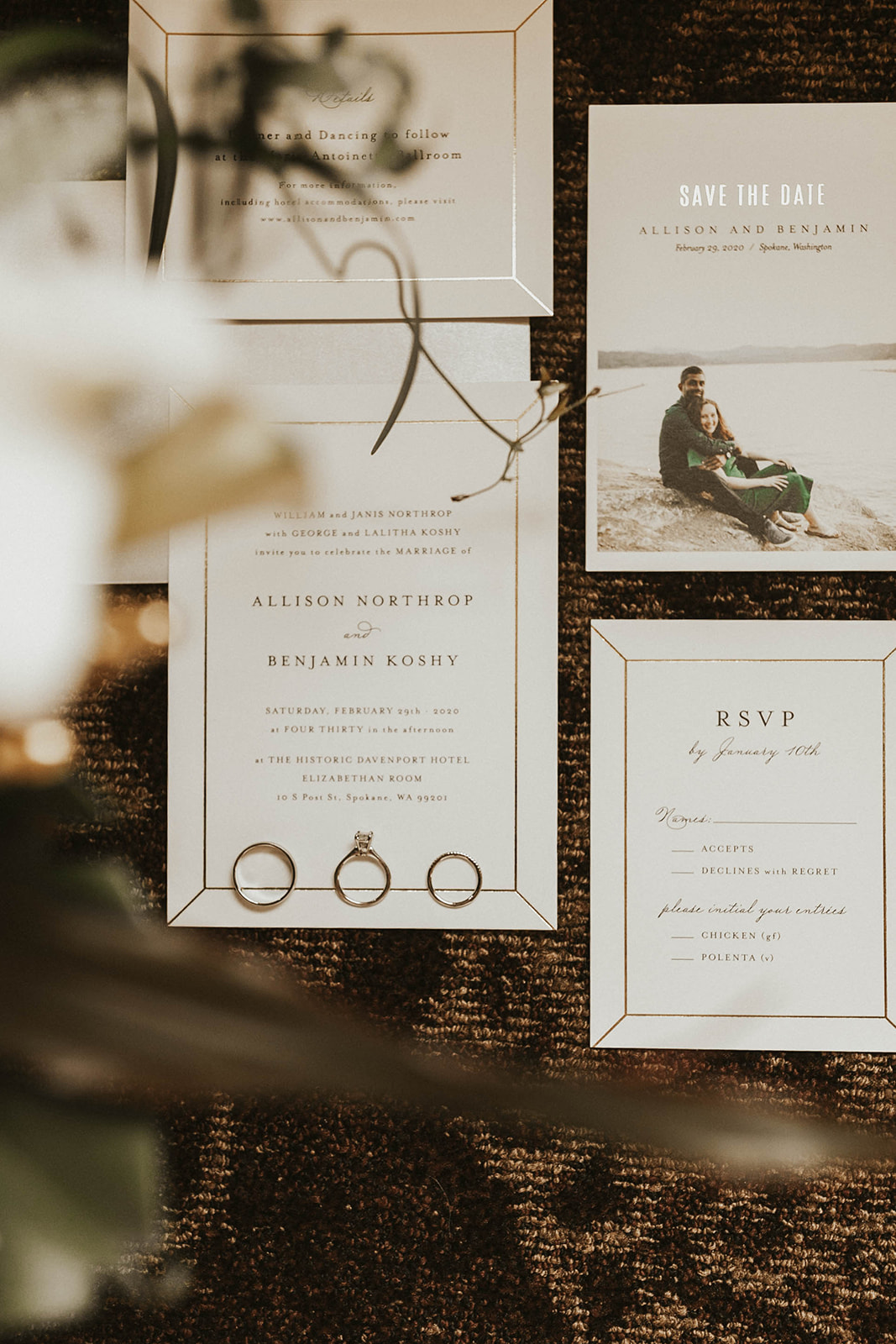
No matter what your invitation looks like, the essential information is generally the same:
Your names, the wedding date, ceremony time, venue name and location, and some direction about what guests should do next.
The wording itself can be as traditional or as modern as you want.
For example:
“Together with their families, ______ and ______ request the pleasure of your company as they celebrate their marriage.”
“Mr. & Mrs. ______ and Mr. & Mrs. ______ request the honor of your presence at the wedding of their children ______ and ______.”
“Mr. & Mrs. ______ request the pleasure of your company at the wedding of their daughter/son ______ to ______.”
Or keep it simple:
“______ and ______ invite you to celebrate their wedding.”
There are plenty of ways to acknowledge parents, stepparents, blended families or other important people without forcing your family into a traditional wording format that doesn’t actually fit.
And if the two of you are hosting the wedding yourselves? Your names alone are perfectly appropriate.
Wedding Date, Time + Venue Information
Next comes the information guests absolutely cannot do without: when and where.
I recommend including the day of the week along with your wedding date, especially if you’re getting married on a Thursday, Friday, Sunday or another less traditional day.
For example:
Thursday, May 14, 2027 at 4:30 in the afternoon
It gives guests one more visual reminder that, yes, you really are getting married on a Thursday.
Your invitation should also clearly list the venue name and city/state. Depending on your invitation design and venue, you may choose to include the full street address on the invitation itself or place it on a details card or wedding website.
Either way, make the address incredibly easy for guests to find. This is especially important for private-residence weddings, rural properties and venues where GPS directions aren’t always reliable.
As a wedding planner in the Inland Northwest, I can tell you that “just Google the venue” is not always the foolproof strategy we wish it were.
What Goes at the Bottom of the Wedding Invitation?
The bottom of your invitation is a great place for one final piece of direction.
That might be:
Cocktail attire
Formal attire
Dinner and dancing to follow
Reception immediately following
Or, if you’re using online RSVPs:
Please RSVP by June 1 at ourweddingwebsite.com
You don’t need to cram every wedding detail onto the main invitation. In fact, please don’t.
Think of the invitation as the headline. Your details card and wedding website can do the heavy lifting.
Do You Still Need Wedding RSVP Cards?
Not necessarily!
Online RSVPs have become incredibly common and can make tracking your guest list, meal selections and other information much easier. If you’re asking guests to RSVP through your wedding website, make those instructions very clear and include an RSVP deadline.
If you prefer traditional mailed RSVP cards, include a card asking guests to provide their name, whether they’ll be attending and any additional information you need from them, such as meal selections. And please include an addressed, stamped return envelope. The easier you make the process, the more likely you are to actually get those RSVPs back without hunting people down three days after the deadline.
Will you still probably hunt down a few people? Yes. Because weddings.
What Information Belongs on a Wedding Details Card?
This is where wedding invitations have changed the most.
You don’t need five tiny cards stuffed into an envelope if most of that information can easily live on your wedding website. A details card can simply direct guests to your website for information about:
- Hotel room blocks and accommodations
- Transportation or shuttle schedules
- Parking
- Welcome parties
- After-parties
- Farewell brunches
- Dress codes
- Destination information
- Registry information
- Frequently asked questions
For a destination wedding or full wedding weekend, I especially love having one central place where guests can find the most current schedule.
Plans change. Shuttle times get adjusted. Locations move. A wedding website can be updated. A printed card sitting on someone’s refrigerator cannot.
How Do You Word an Adults-Only Wedding?
Ahhh, kids. One of the wedding invitation questions couples stress about the most.
First, your guest list is ultimately your guest list. Some couples invite all children. Some invite no children. Others make specific exceptions for immediate family, members of the wedding party or children who have a particular role in the wedding.
Whatever you decide, clarity is your friend. If children are invited, address the invitation to the family or specifically list the invited family members. If children are not invited, address the invitation specifically to the adults who are invited:
Sue & George Parker
rather than:
The Parker Family
Your online RSVP system can also reinforce this by only allowing guests to RSVP for the individuals specifically named on their invitation. I generally prefer clear, neutral wording over trying to disguise the request with something overly cute.
For example:
We respectfully request an adults-only celebration.
Or:
While we love your little ones, our wedding celebration will be adults only. We hope you can enjoy a night out with us!
You can also include this information in the FAQ section of your wedding website rather than putting it directly on the formal invitation.
The biggest thing? Be consistent with whatever parameters you decide on so guests understand where the line is.
What About Plus-Ones?
Another common source of confusion: a wedding invitation does not automatically mean someone has a plus-one.
If a guest is invited with a specific partner, include that person’s name on the invitation whenever possible.
If you’re offering an unnamed plus-one, you can address it to:
Jane Smith & Guest
Your RSVP form should reflect the same thing. Don’t leave an open field where someone invited individually can casually add three more people to their RSVP.
You laugh.
Wedding planners know.
What Should Go on Your Wedding Website Instead?
Your wedding website is one of the best tools you have for preventing the nonstop questions leading up to your wedding.
Use it.
Beyond the basic date and location, consider including hotel information, transportation, parking instructions, your wedding weekend schedule, dress-code guidance, FAQs, registry information and any important venue-specific details.
If you’re hosting a wedding in Coeur d’Alene, Spokane or another destination where many guests are traveling in, you can also include a few recommendations for restaurants, activities and things to do while they’re in town.
Your invitation gets them excited.
Your wedding website helps them figure out the logistics.
Don’t Overcomplicate Your Wedding Invitations
At the end of the day, your guests don’t need an encyclopedia delivered in an envelope. They need to know who, what, when, where and what they’re supposed to do next. Keep the invitation itself beautiful and easy to understand. Use a details card for anything that deserves immediate attention. Let your wedding website house the rest.
The goal isn’t to follow every wedding etiquette rule that’s ever existed. It’s to communicate clearly with your guests so they can arrive ready to celebrate with you, and hopefully save you from answering the same question 47 times the week of your wedding.
And as a wedding planner? That is something I will always support.
If you’re planning a wedding in Coeur d’Alene, Spokane or throughout the Inland Northwest and want some help making sense of all these little details, head over to my Services page to learn more about my wedding planning packages.
And if you’re working on your invitations, chances are your wedding website is next. Check out my Wedding Website 101 blog for what to include, what your guests actually need to know and how to make it another useful tool in your planning process.
Leave a Reply

Our monthly newsletter is a great way to stay up-to-date on all the happenings in the wedding community, get links to the most recent blog posts, and be the first to know when any new digital resources are released!
Stay up to date.